

Headlight relay is a small but important part of a modern vehicle. It helps control the high beams and the low beams of your car. When the relay does not work correctly, then the headlights may not turn on at the same time. That creates a safety hazard, which is why it is crucial to address the problem as soon as possible.
What Is a Headlight Relay and What Does It Do?
A headlight relay is a small electrical switch that controls the power going to your headlights. Instead of running high-current electricity through your dashboard switch, the relay takes that load — protecting the rest of your car’s electrical system from damage.
When you turn on your low beams, the relay closes and sends power straight from the battery to the headlights. Switching to high beams either activates a second relay or shifts the same relay’s circuit path. Because relays are usually mounted in the engine bay, they’re built to handle heat but are kept away from areas where water could pool.
Symptoms of a Bad Headlight Relay
If the headlights do not come on simultaneously, you should suspect that the relay switch is defective. There are two possibilities. The relay could be bad, or the wiring could be faulty. If the wiring is faulty, you will need to track down the problem. A typical relay switch may also have a problem with the contacts. That means that you will have to replace the relay.
Here are some common signs that your headlight relay may have a problem.
1 – The Headlights Do Not Turn On
If your headlights do not come on when you turn the ignition key to start the engine, the problem is most likely with the fuses. Check the fuses if they have blown. The headlights should come on as a secondary function when the engine comes on. The headlights should also turn on when you press the high beams of the switch.
2 – The High Beams Do Not Turn Off
If the high beams do not turn off when they should, the relay is not working. If the low beams are set automatically when the high beams are turned on, then the relay is probably bad. It could also be that the wiring is failing.
3 – The Concealed Headlights Don’t Work Properly
Concealed headlights are very useful in some situations, but they don’t always work the way they should. If the high beams are not coming on, you need to check the relay. The headlights may not be working properly if you have problems with other systems on your vehicle.
Blown Fuse vs. Bad Relay vs. Faulty Switch — Symptoms Compared
| Issue | Common Symptom | Quick Check |
| Blown fuse | Headlights don’t turn on at all | Check fuse box for a burnt/broken fuse |
| Bad relay | Both headlights fail together, or high beams won’t turn off | Voltage drop test (see above) |
| Faulty switch | Inconsistent — works sometimes, needs jiggling | Wiggle test while lights are on |
How to Fix a Bad Headlight Relay: Step-by-Step
If you’ve confirmed the relay is the problem, here’s how to fix it:
- Locate the relay box. It’s usually under the hood, near the battery, inside a labelled fuse/relay panel.
- Identify the correct relay. Check the diagram printed on the inside of the panel cover — it will tell you which slot is the headlight relay.
- Remove the old relay. Pull it straight out; no tools are usually needed.
- Insert a matching replacement. Relays are inexpensive and available at most auto parts stores — match the part number exactly.
- Test your headlights. Turn on the ignition and check both low and high beams.
If the new relay doesn’t fix the issue, the problem is likely in the wiring or the dashboard switch — at that point, it’s worth having a professional take a look rather than guessing further.
How to Test a Headlight Relay (Voltage Drop Test, Explained Simply)
You don’t need to guess whether the relay is bad — you can confirm it in a few minutes with a simple voltage drop test:
- Unplug the relay from its socket.
- Use a multimeter to test the voltage coming into the relay socket (this confirms power is reaching the relay).
- Plug the relay back in and test the voltage going out to the headlights.
- If there’s a noticeable voltage drop between the two readings, the relay is shorted internally and needs to be replaced.
This test takes about five minutes and tells you definitively whether the relay — or something else — is the problem.
Headlight Relay vs. Headlight Switch — How to Tell the Difference
These two parts get mixed up often because their symptoms overlap, but they’re not the same thing:
- A bad relay usually causes both headlights to fail at once, or causes high beams to stay stuck on.
- A bad switch usually causes inconsistent behaviour — lights that work in one position but not another, or that need to be jiggled to turn on.
If replacing the relay doesn’t fix the issue, the dashboard switch is the next thing to check.
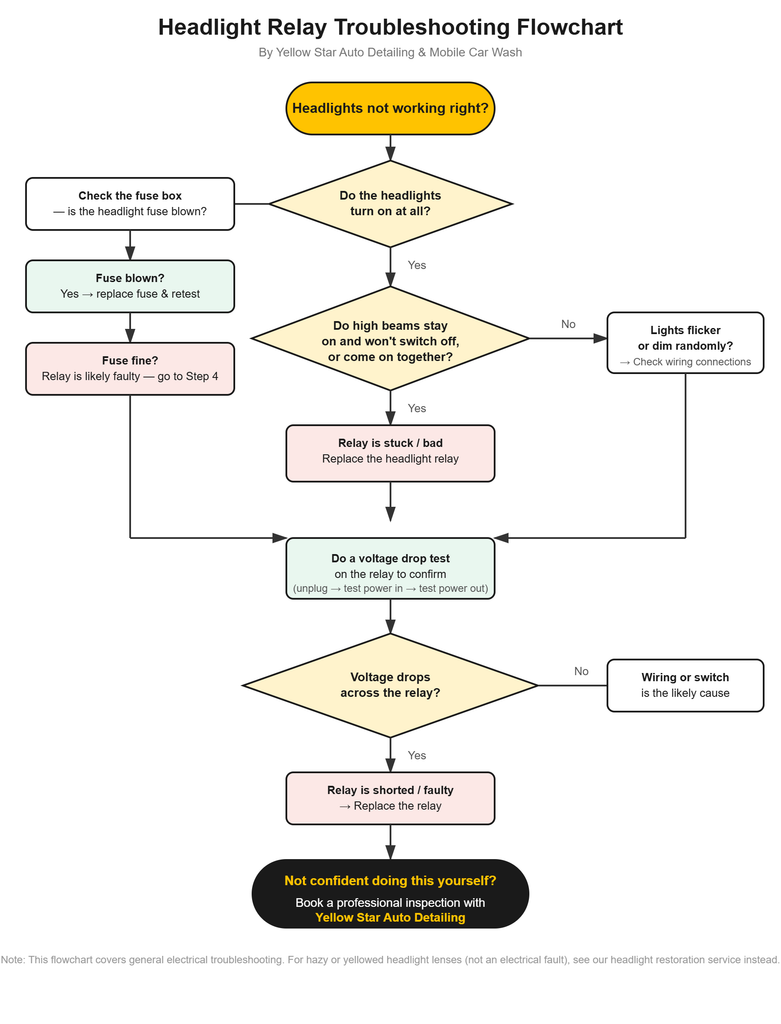
Headlight Relay Troubleshooting Flowchart
FAQs
How much does it cost to replace a headlight relay?
A replacement relay itself is usually inexpensive — often under $20 — since it’s a small, standardized part. The bigger cost, if any, comes from labour if you have a mechanic do it, though most drivers can swap one themselves in a few minutes once they’ve located the right relay.
Can I drive with a bad headlight relay?
It’s not recommended. A failing relay can cause your headlights to cut out unpredictably or your high beams to stay stuck on and blind oncoming drivers — both are safety risks, especially at night or in poor weather. It’s best to get it checked and fixed before your next evening drive.
Where is the headlight relay usually located?
On most vehicles, it’s inside the fuse/relay box under the hood, close to the battery. The cover of the box usually has a diagram printed on the inside showing exactly which slot is the headlight relay — check there first before pulling anything out.
Conclusion
If your headlights are not coming on when they should, you probably have a problem with the relay. You can check the relay, and you can also check the wiring. If the wiring is not faulty, you will need to replace the relay. Acting on it promptly can help you avoid serious problems in the future.
A faulty relay is an electrical issue — not the same thing as headlights that just look hazy, yellowed, or dull from age and sun exposure. If your headlights are working fine electrically but look worn out, that’s a job for our headlight restoration service, not an electrician. Book a headlight restoration and we’ll bring the equipment to you.